
jsc_2026_vol21_article 3
Zines as a Tool for Empowerment in School Counseling
Sarah M. Henry & Sarah Shrewsbury-Braxton
School counselors are tasked with providing K-12 students with direct services to aid in their social-emotional, academic, and career development (American School Counselor Association, 2019). School counselors hold a unique role in schools as both educational and mental health professionals (Levy & Lemberger-Truelove, 2021, p. 2). They are tasked with supporting children and adolescents’ overall development through education about themselves and their mental health. Creative expression can promote this development, and zines (pronounced “zeens”) can be used by school counselors to support youth in individual sessions, small or large group settings, or classroom delivery as they learn to navigate life's challenges and joys.
Zines, small batch self-published booklets, allow for creative expression, often through social commentary from activist-oriented individuals and groups (Mageary, 2020), and can be utilized as a powerful tool in school counseling practices. Zines are individually curated, handcrafted, and are typically displayed in some form of booklet that uses both visual and/or textual components. This art form emerged in the early 1920-30s with science-fiction fans, then exploded in popularity in punk, queer, and feminist social and creative scenes in the early 1980s (Robinson, 2018; Wright, 1999). Although the word zine has a connection to the word magazines, zine historian, Fred Wright (1999), describes how many zine makers prefer not to make this connection since zine represents positive signifiers such as “information” and “love”, while magazine connotes negative signifiers like “product” and “commodity.”
In its current iteration, zines have continued in informal circles, as well as formal settings such as university libraries, museum collections, and electronic archiving systems (Robinson, 2018). Zines have been embraced as a feminist and/or constructivist pedagogical tool across disciplines (Creasap, 2014; Desyllas & Sinclair, 2014; Jones & Granello, 2008). Created and read by youth in social and educational settings, zines can cover a variety of topics from silly to serious, with artistic to analytical underpinnings (Fletcher, 2017). Zines are a flexible medium that can be both read and made with a variety of age groups. The adaptability of zines makes them a helpful tool for the variety of services school counselors deliver to young people in school settings.
Zines as an Expressive Counseling Technique
Zines can be considered a modality of expressive arts therapy, in which creative art forms are used to promote psychological growth, well-being, and healing (Caffrey, 2023). Mageary (2020) describes the multiple purposes of zines as “creating, disseminating, and/or embodying sub- and countercultural beliefs, traditions, and practices as well as facilitating self-exploration, self-expression, and/or self-care" (p. 215). Zines live at the creative intersection of bibliotherapy and narrative therapy. Bibliotherapy is the use of books (physical books, audiobooks, e-books), film, or other storytelling media to increase understanding and promote problem solving within a counseling setting (Marrs, 1995). School counselors and other educators have a long history of incorporating bibliotherapy into their practice by using books to educate, facilitate discussion, and promote critical inquiry with students (Byrd et al., 2021; Mumbauer & Kelchner, 2018). Narrative therapy is a therapeutic approach that underscores the importance of personal stories or narratives to understand life experiences and salient identities, with an emphasis on externalizing problems to allow for reframing (Panina-Beard & Vadeboncoeur, 2024; White & Epston, 1990). Storytelling through zines is an excellent way to help students externalize problems as separate from themselves and allowing for an alternative narrative to reframe their experiences.
Although school counselors are not expressive arts therapists, thoughtfully chosen techniques and approaches can be incorporated into school settings. School counselors can utilize the Expressive Therapies Continuum (ETC) as a framework to identify how students “interact with art media or other experiential activities to process information and form images” (Hinz, 2019, p. 4). The ETC has four levels that incorporate brain functioning processes in both hemispheres. The Kinesthetic/Sensory level emphasizes the movement and sensorial needs of young children who are typically pre-verbal, corresponding to the sensorimotor stage of cognitive development (Piaget, 1969). Children could explore zines that have tactile components or images that encourage movement. At the Perceptual/Affective level, children are exploring and making meaning of the world around them, and their artwork may represent their impulses and emotions. Students at this level could create pictures in a pre-made zine template in response to an issue they are experiencing, such as making friends or experiencing loss and grief. The Cognitive/Symbolic level of the ETC involves complex and sophisticated information processing, consistent with Piaget’s (1969) stage of formal operational thought in adolescence. Middle and high school students could create zines as a tool for advocacy in response to current social issues that impact them, like social media use, mental health issues, or developing healthy relationships. The Creative Level, or the final level of the ETC, can exist at any level of the continuum and serves as an integrative component that emphasizes the joy and therapeutic benefits of being creative.
In addition to developmental levels, it is important for school counselors to integrate multicultural considerations when implementing expressive arts techniques. Culture can influence students’ familiarity and comfort with certain media and materials. Culturally meaningful materials can increase and accentuate the therapeutic effects of expressive arts techniques for students (Hinz, 2019). Additionally, it should be noted that creating zines is more than simply using tools for creative purposes; they can be used as a social experience and process that reflects the cultural context from which it began (Clark-Parsons, 2017). For example, Mageary (2020) found through an extensive literature review that zines have been used as a tool for identity development for people with marginalized identities, and as a process for developing critical consciousness and community engagement.
Zines as a Counseling Tool
As noted, zines can be utilized in a variety of ways, from analyzing stories to constructing stories that promote connection, healing, education, and advocacy. Prior research of zines has highlighted their deep power of individual and communal creative expression (Renk, 2024). Zines can promote connections between peers with similarities and differences, as well as help form social connections and skills. Additionally, zines can be used to engage and empower clients and students.
Zines as a Tool for Connection and Healing
In a survey of zinesters (people who make or read zines), most participants strongly agreed that engagement with zines allowed them to connect more readily with others (Renk, 2024). In a research study investigating the use of zines in a museum setting, researchers found that using zines as a way of engaging in participatory action research (PAR) allowed them to create dialogue across time and space with participants (French & Curd, 2022). This form of connection with others through PAR promoted expression, critical thinking, counter-narratives, and plurality among participants, which was demonstrated in their zines. This sense of freedom of identity and therefore authentic connection with others is mirrored in a study of youth group participants who created zines together. They described their zine group as a place where they felt freedom to be their authentic selves, they were able to explore thoughts and ideas, and they were able to challenge themselves and others (Mieke, 2006). Furthermore, the group fostered deep connections among participants as they created zines together in a collaborative and expressive process. Zines can also be a way to connect with neurodivergent peers through collaborative and connected storytelling (Carette et al., 2024).
Zines can promote healing and empowerment for those who have been marginalized. There is a growing body of mental health related zines that grapple with issues of mental health access, coping skills, mental health journeys, and self-care (Renk, 2024). Mageary (2020), a licensed mental health counselor and professor of Counseling and Psychology, describes zine making as akin to narrative therapy by empowering people to embrace, develop, and express their identities. He also notes how healing it can be to create or recreate stories and narratives (Mageary, 2020). With youth, the power to create, share, and spread unique stories can be healing, improve self-esteem, and promote critical thinking about their identities (Liu et al., 2025; Mieke, 2006). For example, Liu and colleagues (2025) described a workshop of 50 BIPOC youth who made 100 zines in four weeks related to the following reflection questions: “Who are you as a racialized person in relation to your community and to other communities of color? What does mental well-being look like within the contexts of anti-Asian hate and anti-Black racism?” (p. 660). Participants were intentional about including parts of their identities that often felt othered, marginalized, unappreciated, or punished in their zines, therefore giving space to celebrate and share parts of their stories with a collective group (Liu et al., 2025).
Zines as a Tool for Engagement and Empowerment
Zines are a powerful tool to encourage critical engagement with complex ideas in higher education, community work, and school spaces. In a conceptual teaching article, Jones and Granello (2008) describe their use of zines with adults in a counseling program. They theorize that using zines while learning about diagnosing according to the Diagnostic and Statistical Manual of Mental Disorders (DSM) allowed for creative, contextual and constructivist learning (Jones & Granello, 2008). Their use of zines in a semester-long course illustrates a more constructivist approach to teaching by creating space for students to blend what they already know with what they just learned in class.
Zines can help others share skills and information outside of education in a low-budget, low-effort manner (Scheper, 2023). Mageary (2020) describes the use of self-care zines, where individuals share their experiences with mental health issues, explore their values, or create goals through zines, which may tear down barriers to accessing mental health care information. Lilly and colleagues (2024) found that digital zines were an effective way to educate the public about sensitive topics such as sexual and mental health. In community outreach, zines are an accessible tool to share experiences, information, and resources.
Beyond education, zines may be an effective tool for empowerment by creating a space for participants to educate themselves and others about issues that are important to them in ways that represent their voices. This process of self-exploration and creating and disseminating knowledge is a building block for developing critical consciousness, as the creation and dissemination of zines can foster civic engagement and organizing at the grassroots level (Mageary, 2020).
Zines are particularly impactful for marginalized individuals as zines are used to archive community stories, foster connection, explore/challenge stereotypes, and celebrate traditionally marginalized identities. Guzetti and Foley (2017) illustrate these benefits through a case study of a Chicano father who used zines in community organizing and advocacy work around his identities, which included explorations of masculinity and fatherhood. The participant, Tomas, used various forms of literacy to tell his own story, as well as connect with others. Notably, zines can provide a voice for those who feel silenced and have been described as “internally nurturing” (Mieke, 2006, p. 3).
Within schools, zines can help students share their world by helping students feel their identities and stories are allowed to exist, even when they are not celebrated or supported in mainstream society or at school. Scheper (2023) noted how creating zines in schools can be seen as “repurposed productivity,” as a reclaiming of school space to create meaning for themselves (p. 21). School counselors, in tandem with students and librarians, can begin to create a zine library, a collection of zines, in the counseling office, school library, or other spaces in schools where students may be able to access this information freely. By building community through zines, school counselors can spark student-led advocacy focused on topics that matter to students.
Utilizing Zines in School Counseling
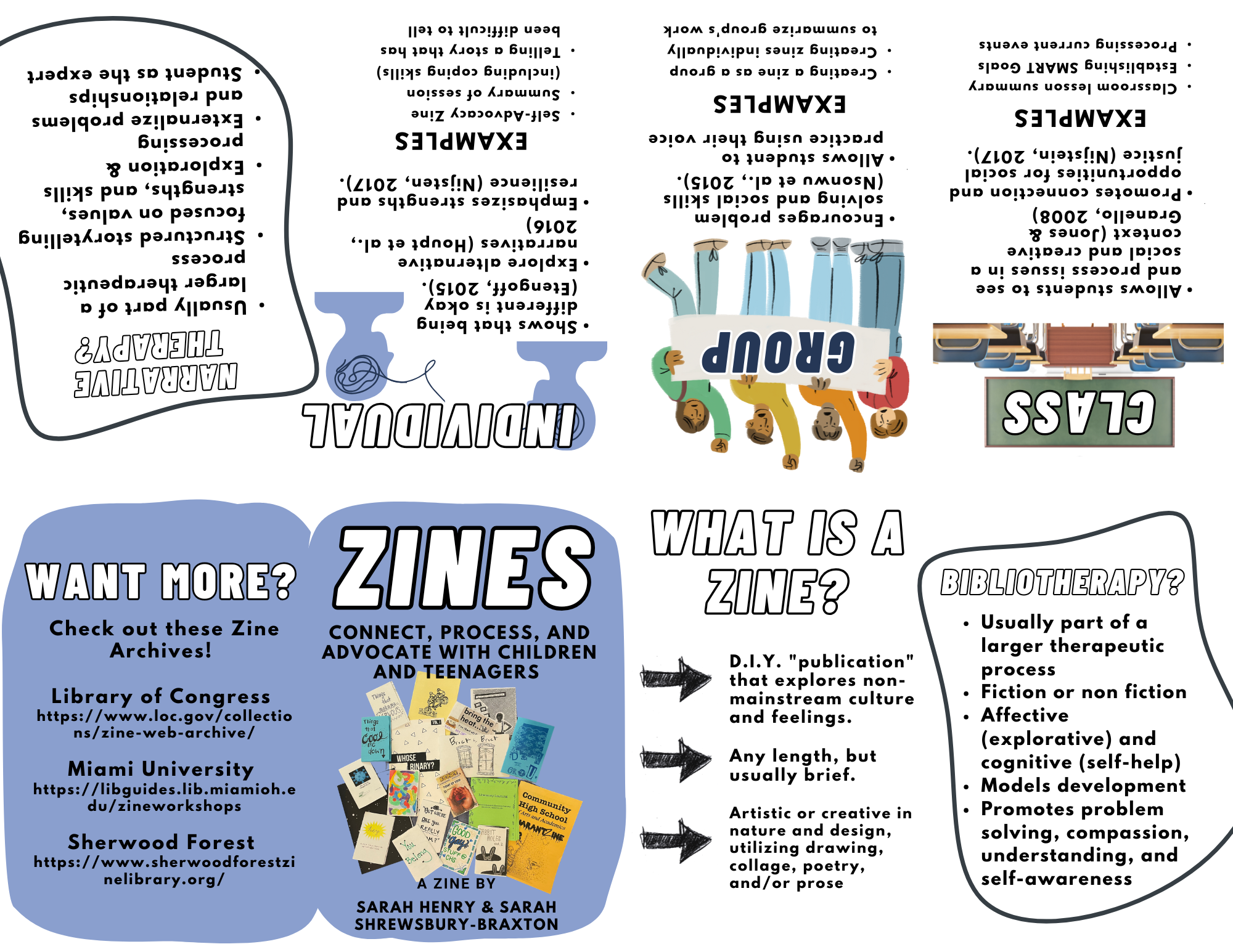
School counselors provide direct services through multitiered systems of support that can include individual and small group counseling, as well as classroom lessons (ASCA, 2019). These services focus on skills and support related to social-emotional, academic, and career development for K-12 students. Zines are a versatile tool that school counselors can use in direct services with students, as they are adaptable to a variety of content that is directly applicable to students, as well as flexible enough to adjust for many stages of development. Much of the next section includes real-life examples from the first authors’ work with K-12 students, pulled from her roles as school counseling intern, full-time school counselor, and now as university supervisor of school counseling interns. These applications are summarized in Image 1, which is a zine created by the authors.
Individual Counseling
Zines can help tell stories, amplify student voices in individual sessions, and serve as reminders of the work that school counselors and students do together. While working as a school counselor, I used zines frequently with students as both a method of seeing other stories represented and as a way for students to summarize our work together. Some of my favorite individual counseling moments occurred with zine work, including a student who created a weekly zine for a few months to discuss where he was “shining light” in his life, despite feeling overwhelmed by sadness and stress. He created a flashlight action figure that would go on adventures in the darkness and shine light on the little things that “kept him going.” He would make these zines outside of our time together (often drawing on the bus), and would share them with me whenever we checked in. I showed him how to make a zine, and we created the first one together, then he went on to create around 6-8 more throughout the semester. By him making these zines outside of the time we had together, our 15-to-30-minute check-ins once per week became more focused and grounded. He typically had a hard time discussing his feelings verbally with me, and this format served as a way for him to tell stories that had been previously hard to articulate.
Affirmations booklets and coping skill reminders were among the most common topics that students and I made zines about. After teaching students breathing or grounding techniques, I would see a student again the following week and more often than not, they had not remembered the coping skill we had previously discussed. I found that by creating coping skill reminders in zine form, students were able to leave with a tangible reminder of the work that we had done together. I often had blank coping skill zine templates, which were essentially worksheet style booklets of steps of recognizing signs they may feel some emotion or feeling in their body (e.g., sweaty palms might mean I am nervous), and what they can do to recognize that in their body and help regulate themselves (e.g., a breathing technique with a step by step guide). Another example of this style of zine where we summarized work together was the affirmation booklets that students would create using their own drawing, writing, and magazine clippings. When negative self-talk would occur and hinder their abilities, we would create affirmations booklets of things they know to be true about themselves (e.g., statements like “I am strong”, and “I can do it”).
Zines can be powerful tools for students to use their voices to advocate for themselves and issues they care about. For example, two mothers of neurodivergent sons created the “AdvocaZine” (see: https://www.theadvocazine.com/) to help their sons identify and communicate their strengths and challenges related to their IEP or 504 (White-Johnson, n.d.). This is an excellent example of how zines can be used by students and their families to help connect and advocate for student needs, as well as facilitate collaboration among stakeholders. In my experience as a school counselor, I also helped facilitate zine-making with students around identities or issues that they had a difficult time sharing with family members or friends. When students made these zines, I noted that they had a better understanding of themselves and how to talk about themselves with other people.
Group Counseling
Using zines in a small group counseling setting can be an exciting and impactful way to connect students with other students and/or with group counseling content. Practicing pro-social skills through the collective creation of a zine can be a powerful way of connecting students with each other, as well as potentially serving as a resource for future students. During my internship experience, I facilitated a small group of queer 12th graders that were headed off to college in the upcoming year. The group focused on transitional skills for college (e.g., finding resources and communities on their new campuses), as well as connecting and processing their time in high school. We explored zines of different identities and stories, as well as created our own collective zine about resources within their high school. We made copies of the collective zine for the other school counseling staff to have in their offices if any other students were interested in learning more about the specific on-site and community resources that this group of students found helpful during their high school career.
Zines can be an engaging way to begin a group, as it can serve as an ice breaker for students to introduce themselves to each other or the group facilitator. Zines can also serve as the primary format to center a group around, somewhat akin to the way that a small group may work through a psychoeducational workbook. For example, the Do You small group uses a zine-based format to explore individuals’ culture, values, experiences, and goals to promote positive development and healthy relationships (Virginia Sexual & Domestic Assault Action Alliance, n.d.). Over the course of 10 sessions, students complete one page of their zine each session, allowing for a comprehension check and format for group discussion. Group members, then, can finish the group with a completed zine that can be used to reflect on their time in the group, and potentially share with others. This style of zine-based small group can also help facilitate connection among multilingual students, as students can use creative expression and a mixture of languages to communicate and engage in the group content. As a supervisor, I aided an intern in the development of a small group with multilingual speakers who engaged in the small group through zine-based curriculum, which allowed them to explore their identities and experiences as they adjusted to their new school and community.
Classroom Curriculum
School counselors can also conduct classroom curriculum using zines as a tool to educate and connect with students. The use of zines as a pedagogical tool can add to a school counselors’ classroom lesson toolbox. Building on the types of zines and content that can be used in small group and individual school counseling, zines can be used in classroom settings to show skill mastery, explore different perspectives, and practice student-led advocacy. Zines can also help promote the navigational capital and skills of students, including academic and career related information for students. We recommend that you explore the Zine Libraries’ resources to learn more about the best practices for using zines in the classroom (see: https://www.zinelibraries.info/running-a-zine-library/teaching-with-zines/).
Using zines to help educate and connect with students related to the academic and career domains of school counseling can create engaging classroom lessons about topics such as graduation requirements, career pathways, and study skills. In my experience, I created a classroom lesson that used zines as a way for 9th graders to explore study skills and resources in the school. We created a zine that included their study plans, organization skills, and educational goals, so that they could visibly and conceptually connect those topics as being related. Additionally, in another classroom lesson, I created a template style zine (already designed and folded, just with blank areas for student responses) to promote a conversation about career planning for 11th grade students. After taking a career interest inventory, we completed the zines as a way of remembering their results from the inventory and connecting those interests to future coursework.
Zines can also be used in social-emotional learning curriculum, to discuss different topics and explore student perspectives. An example of this can look like the
Queer Sex Ed Community Curriculum (n.d.), which provides a variety of zines around sexual education. Additionally, these social-emotional learning curriculum zines can emphasize a variety of topics, including social, empathy, personal safety, and self-motivation skills, such as those outlined in the ASCA Student Standards: Mindsets and Behaviors for Student Success (ASCA, 2021). For example, students can identify self-motivation skills after engaging in a classroom lesson about intrinsic motivation. As a university supervisor, I’ve witnessed interns use zines in classroom curriculum related to mindfulness, coping skills, and psychoeducation. For example, a former school counseling internship student created a classroom lesson to engage in creativity as a form of mindfulness. As a class, they created individual zines where students doodled and drew while music played. In his lesson, the intern also spoke about the influence of music and how it can influence emotional regulation.
Conclusion
Zines are a creative and versatile tool that school counselors can use with students at any developmental level. As a modality of expressive arts therapy, zines can be thoughtfully incorporated into many components of direct service, including individual counseling, group counseling, and classroom lessons. School counselors can leverage the creative possibilities of zines to foster connections, promote healing, provide education, and build advocacy skills with students.
References
American School Counselor Association (2021). ASCA Student Standards; Mindsets and Behaviors for Student Success. Alexandria, VA: Author.
American School Counselor Association (2019). ASCA national model: A framework for school counseling programs (4th ed.). Alexandria, VA: Author.
Byrd., J., Washington, A.R., Williams, J.M., & Lloyd, C. (2021). Reading woke: Exploring how school counselors may use bibliotherapy with adolescent Black boys. Professional School Counseling, 25(1), 1-12. https://doi.org/10.1177/2156759X211040031
Caffrey, C. (2023). Expressive therapies. EBSCO Knowledge Advantage. https://www.ebsco.com/research-starters/psychology/expressive-therapies.
Carette, L., De Bie, L., Brown, K., & De Schauwer, E. (2024). Keeping the conversation going: Rendering each other capable while creating zines. Advance online publication. Qualitative Inquiry. https://doi.org/10.1177/10778004241253263
Clark-Parsons, R. (2017). Feminist ephemera in a digital world: Theorizing zines as networked feminist practice. Communication Culture & Critique, 10(4), 557–573. http://doi.org/10.1111/cccr.12172
Creasap. (2014). Zine-making as feminist pedagogy. Feminist Teacher, 24(3), 155-168. https://doi.org/10.5406/femteacher.24.3.0155
Desyllas, M. C., & Sinclair, A. (2014). Zine-Making as a Pedagogical Tool for Transformative Learning in Social Work Education. Social Work Education, 33(3), 296–316. https://doi.org/10.1080/02615479.2013.805194
Fletcher, N. M. (2017). Designing a space for thoughtful voices: Aligning the ethos of zines with youth-driven philosophical inquiry. Journal of Unschooling and Alternative Learning, 11(22). 53-75.
French, J., & Curd, E. (2022). Zining as artful method: Facilitating zines as participatory action research within art museums. Action Research, 20(1), 77–95. https://doi.org/10.1177/14767503211037104
Guzetti, B., & Foley, L. (2017). Rad dad: A Chicano man (re)constructing masculinity and fatherhood through zines. In E. Ortlieb & E. H. Cheek, Jr. (Eds.), Literacy research, practice, and evaluation (Vol. 8, pp. 89–114). Emerald Publishing Limited. https://doi.org/10.1108/s2048-045820170000008017
Hinz, L.D. (2019). Expressive Therapies Continuum. Taylor & Francis.
Jones, K. D., & Granello, P. F. (2008). Ezines: A constructivist instructional activity for teaching diagnosis and psychopathology. Journal of Creativity in Mental Health, 3(2), 127-138. https://doi.org./10.1080/15401380802226844
Lilly, J. M., Almanzar, D., Pace, S. R., & Bryant, D. D. (2024). Digital zines as mental and sexual health communication tools for Latina teens: Format and content acceptability and initial findings. Health Promotion Practice, 26(5), 926-945. https://doi.org/10.1177/15248399241300570
Liu, R. Z., Liu, W. M., Escobal, L. D., Nguyen, J., Tran, I., & Nguyen, S. (2025). Our stories of origins: Decolonial healing through zines and zine-making. American Psychologist, 80(4), 655-660. https://doi.org/10.1037/amp0001453
Levy, I. P., & Lemberger-Truelove, M. E. (2021). Educator–Counselor: A nondual identity for school counselors. Professional School Counseling, 24(1_part_3). https://doi.org/10.1177/2156759X211007630
Mageary, J. (2020). Zines, the DIY ethic, and empowering marginalized identities. In Leone, L (Ed.), Craft in art therapy: Diverse approaches to the transformative power of craft materials and methods (pp. 215-231). Taylor & Francis Group.
Marrs, R. W. (1995). A meta-analysis of bibliotherapy studies. American Journal of Community Psychology, 23(6), 843-870. https://doi.org/10.1007/BF02507018
Mieke, M. (2006). Zine is believing: The personal growth of five contributors to a youth magazine. [Master thesis, University of Northern British Columbia]. https://doi.org/10.24124/2006/bpgub395
Mumbauer, J., & Kelchner, V. (2018). Promoting mental health literacy through bibliotherapy in school-based settings. Professional School Counseling, 21(1), 85-94. https://www.doi.org/10.5330/1096-2409-21.1.85
Panina-Beard, N. & Vadeboncoeur, J. (2024). Narrative therapy. EBSCO Knowledge Advantage. https://www.ebsco.com/research-starters/social-sciences-and-humanities/narrative-therapy.
Piaget, J. (1969). The psychology of the child. New York, NY: Basic Books.
Queer Sex Ed Community Curriculum. (n.d.). Zines. Queer Sex Ed Community Curriculum. https://www.queersexedcc.com/zines
Renk, C. (2024). Zines and therapeutic benefits ii [Master thesis, Indiana University]. https://hdl.handle.net/1805/41531
Robinson, L. (2018). Zines and history: Zines as history. In The Subcultures Network (Ed.), Ripped, torn and cut (pp.39-54). Manchester University Press. https://doi.org/10.7765/9781526120601.00010
Scheper, J. (2023). Zine pedagogies: Students as critical makers. Radical Teacher, 125. https://doi.org/10.5195/rt.2023.963
White, M. & Epston, D. (1990). Narrative means to therapeutic ends. W.W. Norton Company.
White-Johnson, J. (n.d.). AdvocaZine. Jen White-Johnson. https://jenwhitejohnson.com/The-Advocazine-Hack-The-IEP
Wright, F. (1999). The history and characteristics of zines. The Zine & E-Zone Resource Guide. https://zinebook.com/resource/wright1.html
Virginia Sexual & Domestic Violence Action Alliance (n.d.). Do You Tools. Do You. https://www.doyoutools.org/