
JSC 2026 Vol21 Article 5
Pages of Progress: Professional Practices of School Counselors
Jill S. Minor, Kimberly Farley-Smith & Jack Barron
School counselors play a crucial role in student achievement and academic well-being, and are responsible for addressing their students' social, emotional, academic, and career needs. Professional development is the key to equipping them with the knowledge, clinical skills, and strategies to meet these needs effectively. This ongoing, lifelong learning ensures school counselors are continuously updated on educational trends and evidence-based practices, motivating them to fulfill their professional and ethical responsibilities. With the increasing mental and emotional health needs of students, there is an increased demand for more intentional and appropriate professional development opportunities for school counselors, specifically related to counseling skills. Clinical counseling skills are essential to ensure school counselors are adequately prepared to support students' career, academic, and mental and behavioral health needs and to engage in counseling practices effectively (Dahir & Stone, 2024). Clinical training defines the scope of practice and professional responsibilities, laying the foundation for their professional school counselor identity (PSCI) (Lowery et al., 2018). The multifunctional roles that school counselors play are significant in PSCI development, increasing self-confidence and self-efficacy (Harrison, 2022). School counselors have an ethical imperative to act in the best interests of all students, ensuring their well-being and development, especially when there is a positive correlation between a school counselor's skill level and improved student outcomes (Lambie et al., 2019; Mulhern, 2020). However, researchers indicate many school counselors are not well prepared to provide counseling services to meet the mental, emotional, and behavioral needs of students (Gilfillan, 2017; Parikh-Foxx et al., 2020) and are not receiving the relevant or practical professional development to cultivate their professional school counselor identity (PSCI) (Kneale et al., 2018; Minor & Duchac, 2023; Rock & Curry, 2021; Young & Kaffenberger, 2016) Traditional professional development for school counselors often relies on expert-led conferences or training sessions that may lack relevance and practical application for addressing students' complex mental and behavioral health needs. Because researchers indicate that many school counselors are not receiving the practical professional development needed to cultivate their professional identity, there is a pressing need for more creative and intentional training opportunities focused on counseling skills. Practical and creative approaches drive innovation and sustenance in professional learning and practice (Kim, 2016). Applying this principle, this article explores such an innovative alternative: a virtual book club that replaces passive training with a self-directed, collaborative environment for practitioners and trainees. What makes this approach ingenious is its shift to a social constructivist framework, where the curriculum is co-created through professional experiences and reflective discourse rather than a top-down expert model. In practice, this shift enables school districts to build a highly scalable model for redesigning professional development. This article provides a structured design, including text selection, scheduling, and modality, that can be adapted to specific district needs. By bridging the gap between theory and practice, this professional development model enhances the delivery of intentional counseling services to improve mental health and wellness outcomes. To assess this potential, the present study will investigate an innovative framework that incorporates book clubs as a professional development intervention for school counselors and school counselor trainees (SCITs).
Literature Review
Professional School Counselor Identity (PSCI)
Professional identity is defined as an individual’s self-concept and understanding of their role within their field (Mullen et al., 2019). For school counselors and school counselors-in-training (SCITs), developing a robust Professional School Counseling Identity (PSCI) is essential for effective practice. Rather than a static milestone, PSCI is a continuous evolution shaped by educational training, field experiences, and the unique dynamics of the school environment (Brott & Myers, 1999). Integration of creativity and reflective practices further refines this identity, aligning clinical skills with student needs (Maor & Hemi, 2021; Brown et al., 2017). Ultimately, a strong PSCI empowers school counselors to navigate complex roles with a clear sense of purpose, fostering the self-efficacy needed to implement comprehensive programming with diverse student interventions.
Professional Learning for Adult Learners
Andragogy, the science of adult learning, emphasizes self-directed and experiential growth (Lukyanova & Anishchenko, 2014; Machynska & Boiko, 2020). Knowles (2019) identifies six core assumptions of this model: learners must understand the purpose of study, possess a self-directed concept, draw upon prior experience, demonstrate readiness based on real-life needs, maintain a problem-centered orientation, and exhibit intrinsic motivation. Within this framework, the leader transitions from a director to a facilitator (Alabisi & Vucetic-Trifirò, 2023). This facilitative shift is naturally professional learning, such as in book clubs, which provide a self-directed environment where members leverage their prior experiences to co-construct meaning from a text.
Professional Book Clubs
To promote student wellness, school counselors must continually strengthen the attitudes, knowledge, and skills required for effective mental health support (ASCA, 2020). Professional book clubs offer a practical, empowering medium for this growth (Minor & Duchac, 2023), fostering improved student outcomes through collaborative learning (Milsom, 2010). Unlike traditional expert-led training, these school counselor-driven discussions encourage participants to integrate personal insights and diverse perspectives, deepening professional connections (Lyons & Ray, 2014; Robertson & Smith, 2017). Ultimately, the shared exchange of ideas, rather than the text individually, drives significant professional development (Alghamdi, 2022). However, the impact of book clubs has not been qualitatively studied specifically with school counselor participants. Consequently, evaluating the effectiveness of the online book club format as a creative intervention for this population is essential.
Study Rationale and Research Questions
To address the need for continuous educator training and the ethical imperative of school counselor development, this study aimed to create and evaluate an online book club learning experience for school counselors and school counselors in training (SCIT). The goals of the online book club learning experience was to: (1) introduce school counselors in training (SCIT) to the importance of personal and professional development as a component of professional training; (2) expose school counselors and SCIT to evidence-based practices; and (3) foster a culture of metacognition and reflection that may inform, shift and then sustain their pedagogical belief and clinical practice. To evaluate the professional development model, research questions guided this intervention: (RQ1) How do school counselors in Ohio experience a professional online book club focusing on clinical skill development? (RQ2) How do SCITs experience a professional online book club focusing on clinical skill development?
Method
To address the above research questions, the researchers designed an online questionnaire survey. Such a design allows researchers to collect both qualitative and quantitative data with feasibility and expedited distribution (Regmi et al., 2016). The study focused on practicing school counselors and their experiences in a professional learning book club. The following subsections detail the participants, measures, procedures followed, and data analysis.
Participants
Participants in this study were full-time school counselors and SCITs in the state of Ohio. Prior to participant recruitment and data collection, the institutional review board (IRB) at the researchers' institution reviewed and approved the study. A total of 21 participants responded to the invitation to participate in the book club intervention. The final sample of participants in the book club professional learning intervention was (N=10), of which (N=8) participated in the study. Basic demographic statistics were not collected due to the small sample size. Upon consent to participation, the subjects were directed to Qualtrics to complete the survey.
Measures
As online delivery is now the dominant method for survey research, the researchers chose an anonymous, online, researcher-created survey (Toepoel, 2017).. The anonymous response mode provided participants with greater comfort in honestly expressing their opinions and experiences (Braun et al., 2017; Terry & Braun, 2017). The questionnaire consisted of two parts, totaling 11 questions. The first section included six Likert scale items. The second section consisted of five open-ended response questions regarding participants' growth and impact on their counseling skill development. An online survey, particularly its qualitative elements, provides a platform for participants who may prefer not to engage in face-to-face research due to the intimate nature of the experience (Davey et al., 2019). To assess the impact of the online book club, the researchers examined and reported descriptive statistics for survey items with distinct answer responses. For qualitative data responses, the researchers performed a thematic qualitative analysis. The two researchers, experienced in qualitative methods, independently analyzed the free-response data line by line to identify recurring concepts and assign codes, which were further refined into themes using a thematic analysis approach. The thematic analysis enabled the researchers to provide an avenue for interpreting selected codes and constructing themes, allowing for flexibility in adapting the approach to the specific research questions and contexts (Kiger & Varpio, 2020). Furthermore, the thematic analysis provided a means to understand a set of experiences and thoughts across the dataset (Braun & Clarke, 2012); thus, underlying meanings and connections within the collected data were identified.
Trustworthiness
Trustworthiness and reflexivity were established through the researchers' extensive professional experience and a systematic, collaborative analysis process. Both the first and second authors hold doctoral degrees and serve as practitioner-scholars in the field. The first author has 20 years of experience as a school counselor across all K–12 levels and has prior expertise in implementing professional development book clubs. The second author holds a Master’s degree in school counseling and has served as a teacher, administrator, and career specialist. Employing a social constructivist lens, the researchers acknowledged that their lived experiences influenced their interpretation of participants' constructed realities. To ensure methodological rigor, both researchers independently conducted line-by-line coding of the qualitative data. They then engaged in a consensus-building process to compare and fine-tune these codes into the final three themes, following Braun and Clarke’s six-step thematic analysis framework. The use of an anonymous online survey further encouraged honest disclosure, consequently enhancing the credibility and integrity of participants' responses.
Procedures
Book clubs as professional learning experiences require a structured experience grounded in research and reflection (Minor & Duchac, 2023; Sedo, 2003). Unlike traditional in-service training, which often lacks ongoing support, this practitioner-focused educational opportunity cultivates collaboration between experienced counselors and trainees, facilitating an exchange that reduces hierarchical barriers and emphasizes practical application. By replacing passive instruction with a social constructivist, peer-led community, the book club as a professional learning opportunity advances beyond rote information delivery found in most conventional development formats to promote active professional synthesis. This approach ultimately provides a more relational and sustainable alternative to conventional training by centering learning on communal reflection and the intentional development of professional identity.
The researchers designed the book club intervention using multiple sources, including professional literature on best practices and suggestions for implementing book clubs, as well as the ASCA Ethical and Professional Standards (2022). Finally, a social constructivist approach provided the theoretical underpinnings for the intervention. The design structure was intentionally delivered to align with suggestions outlined by Landry and colleagues (2022), including the selection of a compelling and relevant text, structure, and modality, as well as advertising, scheduling, meetings, and outcomes.
Choosing a compelling and relevant text. The researchers purposefully selected the book entitled Solution-Focused School Counseling: The Missing Manual (2020) by Dr. Russell A. Sabella because it offers practical tips and suggestions for counseling skill development, as well as the first author's prior experience with the book, having led another professional development book club as a school counselor.
Structure and modality. Participants comprised approximately 9 participants (a range of five professional school counselors and four school counselor trainees in their internship course), with two members serving as book club facilitators. Participants received books to use, completed individual reading assignments, and participated in online learning and discussion sessions.
Advertising. The book club leaders sent electronic flyers to practicing school counselors in the Miami Valley area of Ohio and to SCITs interning at the researchers' institution. If interested in participating in the book club, the school counselor or SCIT completed the form. They had roughly three weeks to respond to the invitation.
Scheduling. The PD intervention was a four-session professional development intervention that required approximately 35 hours of reading. During the two-month timeframe, the participants met four times (Weeks 2 and 4 during June and July) for approximately 2 hours each (2 pm-4 pm) for a total of eight meeting hours. Accordingly, the book was divided into four chapters, assigned for each meeting.
Meetings. This book club was divided into four parts. Each participant was directed to read the assigned section, analyze strategies from the book, and then come to the book club prepared to share how they could implement these strategies in their professional practice. The book club leaders were facilitators of the discussion.
Outcomes. After the completion of the book club intervention, the participants received an anonymous online evaluative survey via email.
Analysis
The researchers employed online survey research as the primary method of data collection, utilizing both quantitative and qualitative data elements and analyses. The researchers used a concurrent data collection method to simultaneously gather quantitative and qualitative data, thereby providing a comprehensive understanding of the participants' experiences in the virtual book club. The researchers analyzed the quantitative results, followed by the qualitative data. To measure the impact of the book club, the researchers analyzed and reported descriptive statistics for survey questions with distinct response options, as well as open-ended response questions. Creswell and Poth (2018) illustrate data collection as a continuous and interconnected process, and employing the five data collection approaches enables the consideration of ethics and the acquisition of rich and valuable data. To maintain methodological rigor and transparency with the qualitative responses, the researchers followed Braun and Clarke's (2013) six-step thematic analysis as a guide to conduct the thematic analysis (1) familiarize themselves with the data; (2) generate initial codes; (3) search for themes; (4) review themes; (5) define and name the themes; and (6) produce a final analysis and description of findings. Thematic analysis is particularly helpful for researchers conducting more practitioner-oriented or applied research approaches (Braun & Clarke, 2014).
Results
Descriptive Statistics
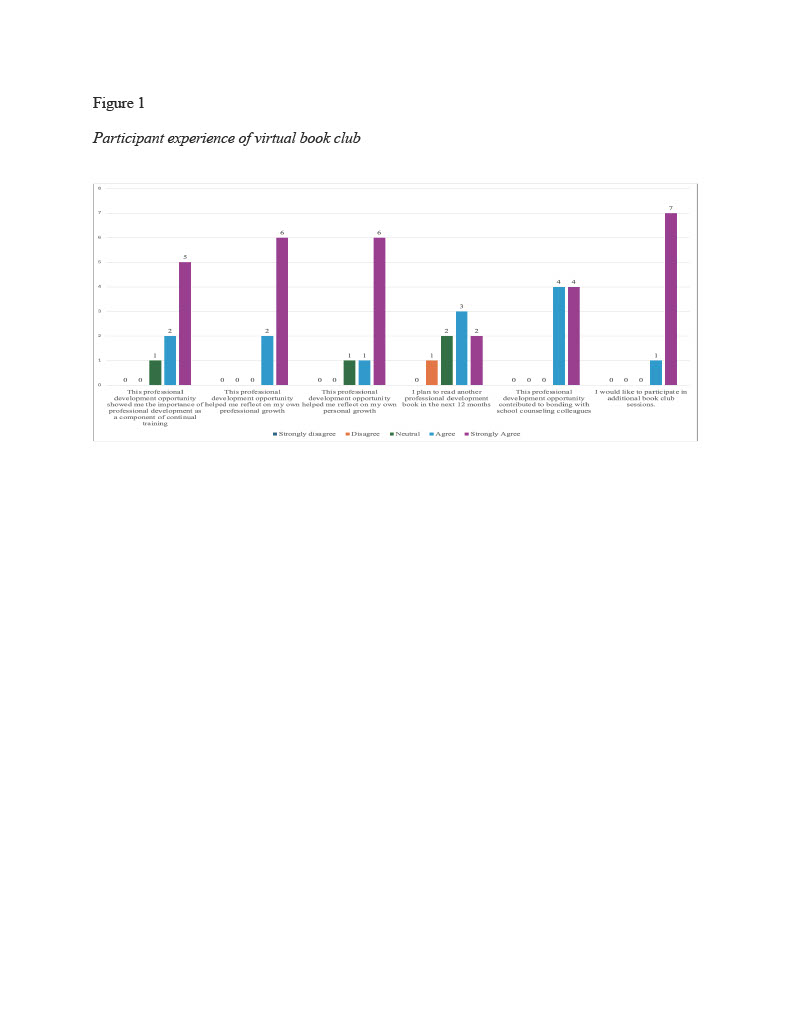
Participants responded to a five-point ordinal Likert scale survey evaluating their experiences in the virtual book club and its perceived impact on professional development. The Likert scale ranged from "strongly disagree" to "strongly agree," which allowed participants to express their level of agreement with each statement. The results from Table 1 presents the distribution of participant responses for key survey items. A majority of participants (50%) agreed the book club provided continual training. Reflecting on their professional growth, 88% of participants agreed and strongly agreed that the virtual book club had a positive impact on their professional development. Overall, 88% of participants indicated a high level of satisfaction with the level of reflection on personal growth that resulted from participating in the virtual book club. Participants' responses were varied on the item of future plans to read another professional development book within the next year. While 63% of participants indicated agreement or strong agreement, 25% of participants selected a neutral response. However, 50% of participants agreed and strongly agreed that the virtual book club contributed to improved collegial relationships. Additionally, interest in future book club sessions was notably high, with all participants indicating a strong desire for ongoing engagement in additional virtual book clubs. Overall, participants’ responses indicated virtual book clubs were perceived as a beneficial professional development experience. Survey results further suggest the format supports personal development that contributed to collegial connections amongst participants.
Figure 1
Participant experience of virtual book club
Based on the research questions and the thematic analysis of participant responses, three themes emerged from the data: (1) Space to Grow, (2) Power of Connections, and (3) counseling skills enhancement. These themes reflect participants' perceptions of how the virtual book club supported their professional development, shaping their counseling practices and collegial relationships. Thematic analysis followed Braun and Clarke’s (2006) six-phase process and was developed through coding and a comparison of participant responses.
Theme One: Space to Grow
The theme Space to Grow highlights the critical need for supportive environments that foster both professional and personal development among school counselors and SCITs. All participants described the virtual book club as a valuable platform for personal and professional growth. One participant discussed the learning environment as "I feel that this club gave me a safe space to learn and grow with other school counselors. I feel more connected and supported.” Another participant, who identified as a counselor trainee, echoed a similar sentiment about the learning space: "This opportunity allowed me to reflect on my professional growth and what areas I can improve. It gives me resources for my future as a counselor." While another participant shared how the book club provided a reflective learning space by "hearing from others' experiences, thoughts, and ideas allowed me to reflect on my own counseling and what I can use or adapt moving forward in my career."
Theme Two: Counseling Skills Enhancement
This theme reveals participants’ perceptions of how the virtual book club contributed to Enhancing Counseling Skills among the participants. All participants reported various ways in which the virtual book club impacted professional practice. Several participants noted that the virtual book club introduced them to counseling concepts they had not previously encountered. For example, one participant shared that "I think reframing and focusing meetings and discussions to a more positive and solution-focused mindset is something I plan to incorporate." Another participant explained that through their book club experience, they "sharpened my proverbial counseling blade." Other participants emphasized the transition from learning about a strategy or skill to intentional application in future counseling practice, as one participant explained: “I plan to incorporate many of the individual and group components/activities and also specific parts for meeting with teachers and parents. I think reframing and focusing meetings and discussions to a more positive and solution-focused mindset is something I plan to incorporate.” Similarly, another participant described the book content to real-word practice as "gave me reminders, helped me learn from others and develop skills I will use in sessions with staff and with families," further, emphasizing how virtual book club participation influenced the intentional practice and application of newly acquired skills in the field of school counseling.
Theme Three: Power of Connections
The Power of Connections underscores the profound impact of meaningful professional relationships on school counselors' identity and effectiveness. Multiple participants commented on the word “confidence”. This idea of “confidence” unfolded in two primary areas: personal self-assurance and clinical counseling skills. In terms of personal growth, a participant shared, “This allowed me to recognize strengths and weaknesses I have and how I can specifically embrace my strengths and develop things that come challenging to me.” Another participant highlighted the power of connections within the book club to their professional and personal self as, "positive, solution-focused, growth mindset is a necessity in schools. These principles are mood and thought enhancing and benefit me, allowing me to be the best version of myself.” Others described how collegial interaction during the sessions helped them feel supported and validated, thus enhancing a sense of belonging, as one participant shared "hearing from others and trying to summarize their thoughts and ideas in ways that made sense to me was helpful."
Discussion
The current study explored the perceptions of school counselors and school counselors-in-training (SCITs) regarding their experiences in a virtual book club on their professional and personal development. The three themes included (1) Space to Grow, (2) Counseling Skills Enhancement and (3) Power of Connections. The thematic findings demonstrated the impact of the virtual book club on professional and personal growth and additionally highlighted the interplay between participation in a virtual professional development opportunity and professional growth in the field of school counseling.
The literature highlights a gap between the level of preparation of school counselors to provide counseling services and the lack of relevant and practical professional development promoting growth in these areas to meet the mental, emotional, and behavioral needs of students. The theme, Space to Grow, highlights the significance of creating a supportive environment and emerged as a creative intervention to bridge the gap of fostering a safe space for professional and personal growth of school counselors and SCITs. The findings from this study concur with the previous literature suggesting the need for relevant and practical professional development to meet the mental, emotional, and behavioral needs of students (Gilfillan, 2017; Parikh-Foxx, et al., 2020). These findings were congruent with previous research, including a qualitative study of preservice and practicing teachers that identified the utility of the book club format on thinking and reflecting on professional practices (Burbank, et. al, 2010). The findings also corresponded to the vocational work of Porath (2018) and White (2016), who found the power of developing relationships and a sense of community with colleagues in book clubs to be a critical component of professional learning among educators. This study is unique as it was the first to apply a book club as professional learning with school counselors and SCITs.
Practical application of new skills gained through the virtual book club, which is aligned to the literature of the importance of skill development in improving student outcomes. Participants highlighted how the virtual book club provided practical reminders and facilitated skill development applicable across various professional interactions. The participant feedback offers evidence for the effectiveness of virtual book clubs as a mechanism for counseling skill enhancement. It reinforces the significance of innovative pedagogical approaches in school counseling professional development. Theme two, Counseling Skills Enhancement, indicated that the integration of clinical skill-focused learning within a book club setting may represent a substantial contribution to the sustained professional advancement of practicing school counselors and trainees and extends to the school counseling literature.
The literature emphasizes that reflective practice and continuous learning, often facilitated through strong connections, can significantly enhance school counselors' professional identity and their ability to meet the needs of students and the community (Gibson, 2012). This ongoing development is intrinsically linked to building robust professional networks. By fostering these connections, school counselors can strengthen their PSCI and leverage collaborative relationships to provide more personalized student support. The integration of this collaborative learning experience demonstrably contributed to the continuous development of school counselors' PSCI and highlighted the critical value of professional connections in their ongoing development. The findings reveal that participants perceived the virtual book club as a supportive and safe learning environment that facilitated both personal and professional growth. The data indicate the virtual book club created a space of self-reflection and connection with others in the field, thus participants indicated the valued opportunity to examine their counseling practices and identify areas of continued growth that shapes the PSCI. These findings align with theme three: Power of Connections, underscoring how meaningful peer interactions are foundational in building confidence and shaping PSCI of SCITs and school counselors.
Therefore, this study extends the format to a new professional group, thereby emerging as novel contributions to the literature on professional learning study following the philosophical assumptions derived from a social constructivist paradigm where participants were asked open-ended questions, allowing for participants to describe their own experiences fully and freely (Creswell, 2013). The researchers listened to the participants' views and interpreted the findings based on their lived experiences and background, which revealed a significant amount of information regarding the participants' experiences during participation in the virtual book club. The study operated under the assumption that the participant's reality is constructed and interpreted based on their own unique experience and perspectives. Hence, applying the social constructivist framework helped gauge the views influencing the individual words of the participants.
The key findings of this study underscore the experiences of participants in the virtual book club as a novel intervention on professional learning. The implications of this novel professional learning intervention and positive outcomes shed light on the effectiveness of virtual book clubs in the professional and clinical development of school counselors and SCITs. The virtual book club enhanced understanding of the importance of personal and professional growth as a school counselor and SCIT and provided an avenue to connect and bond with colleagues. The reflections of participants suggest a virtual book club supports self-efficacy and the development of clinical confidence, thus reinforcing the value of peer-based professional development. Furthermore, the results corroborated with the existing research that recognizes the need for relevant and practical professional development. The virtual book club emerged as an effective tool for supporting PSCI development; thus, the interactive nature of the virtual book club proved to be a creative and supportive intervention for school counselors and SCITs.
Limitations, Implications for Practice, and Future Research
Limitations
Despite the encouraging findings of this study and given the preliminary nature of the research, a few limitations are notable. This study focused on a small sample of school counselors and SCITs (eight of 10 recruited participants) from one Midwestern state who attended a virtual professional development book club event. As such, the findings of this study should not be generalized to the broader population of school counselors/trainees or all professional development focusing on school counseling knowledge and skill development. Second, this study only extended to the conclusion of the four book club sessions. Therefore, there is a need for more data on how participants apply their learning to professional practice. Although the facilitators encouraged open dialogue and asked for explicit feedback, participants might have withheld criticisms or concerns due to social desirability. The facilitators tried to foster an environment of open dialogue between facilitators and participants, with repeated reminders that they sought positive and critical feedback for improvements.
Implications for Future Practice
Implications for practicing school counselors and trainees, as well as recommendations for future practice, are pertinent to the results of this study. The current results may indicate that book clubs represent a promising strategy for enhancing knowledge and clinical skill development for school counselors. Participants in the study talked about a safe and cooperative space for learning. The facilitators crafted a unique virtual book club experience for school counselors/trainees to (re)ignite focus and awareness of clinical skill development and ethical practice. The goal of having experienced counselors and trainees dialogue about essential clinical practice issues is valuable and could benefit school counselors at both ends of the experience continuum. Using practical professional learning fundamentals intentionally initiates a fundamental shift from antiquated and ineffective practices to engaging school counselors and trainees in opportunities to enhance their professional practices. The use of virtual book clubs as a professional development format aligns with the principles of andragogy, which emphasizes self-directed and collaborative learning that is reflected in the core elements of the book club structure. Overall, the accessibility, brevity, and andragogical strategy of book clubs make this learning format an exciting possibility for impacting school counselors' and trainees' knowledge and clinical skill practices.
Implications for Future Research
This research inquiry contributes to a limited body of research examining school counselors’ and SCITs’ experiences participating in a virtual professional development book club. Because it is a novel inquiry, more analysis is needed to explore the findings of book club professional learning and the impact on clinical skill development. Future research should be longitudinal, encompassing both school counselor and SCIT learning about clinical skill practices and their attempts to apply in professional practice after a professional learning experience. Future studies could also analyze how other skill development options (such as a formal skills class or online/face-to-face workshops) compare to a book club format. Overall, this book club design may serve as a framework for other researchers to utilize this method of professional development for school counselors and SCITs. Although preliminary, the successful and positive feedback from participants suggests that this model may be worthy of further exploration in other settings as a professional development tool for trainees, site supervisors, and practicing school counselors.
Conclusion
This study highlights the potential of professional book clubs as an effective and meaningful intervention in the continuous development of school counselors and SCITs clinical skills development and PSCI growth. The present study adds to a growing body of evidence indicating school counselors and SCITs report significant benefits from participating in a virtual book club collaborative learning experience. The book clubs facilitated the enhancement of counseling skills through an innovative approach while reinforcing the importance of clinical skill development into personal and professional growth opportunities. The findings support that concerted learning efforts are imperative to improving clinical skill development within a comprehensive school counseling program, which will benefit students. Ultimately, this study demonstrates the far-reaching impact of innovative and creative professional development opportunities fostering personal and professional growth.
References
Alabisi, A., & Vucetic-Trifirò, C. E. (2023). Pedagogy, Andragogy and Heutagogy: How are they related? E-Journal of Business Education & Scholarship of Teaching, 17(2).
Alghamdi, D. J. (2022). The impact of using book clubs among female teachers in their professional development in Saudi Arabia. Cogent Education, 9(1). https://doi.org/10.1080/2331186X.2022.2090190
American School Counselor Association. (2020). The school counselor and student mental
health. Alexandria, VA: Author.
American School Counselor Association (2022). ASCA ethical standards for school counselors. American School Counselor Association.
Braun, V., & Clarke, V. (2013). Thematic analysis. American Psychological Association.
Braun, V., Clarke, V., & Gray, D. (2017). Innovations in qualitative methods. In B. Gough (Ed.), The Palgrave handbook of critical social psychology (pp. 243–266). Palgrave Macmillan.
Brott, P. E., & Myers, J. E. (1999). Developing professional identity in counselors-in-training:
The role of supervision and the influence of professional organizations. Counselor Education and Supervision, 38(1), 21-35. https://doi.org/10.1002/j.1556-6978.1999.tb00555.x
Brown, C. H., Olivárez, A., & DeKruyf, L. (2017). The Impact of the School Counselor Supervision Model on the Self-Efficacy of School Counselor Site Supervisors. Professional School Counseling, 21(1). https://doi.org/10.5330/1096-2409-21.1.152
Burbank, M. D., Kauchak, D., & Bates, A. J. (2010). Book clubs as professional development
opportunities for preservice teacher candidates and practicing teachers: An exploratory study. The New Educator, 6, 56-73.
Creswell, J. W. (2013). Qualitative Inquiry & Research Design Choosing among Five Approaches (3rd ed.). Thousand Oaks, CA SAGE.
Creswell, J. W., & Poth, C. N. (2018). Qualitative Inquiry and Research Design: Choosing among Five Approaches (4th ed.). Washington DC: Sage Publications.
Dahir, C.A., & Stone, C. B. (2024). The transformed school counselor. Belmont, CA: Cengage.
Davey, L., Clarke, V., & Jenkinson, E. (2019). Living with alopecia areata: An online qualitative survey study. British Journal of Dermatology, 180(6), 1377–1389. https://doi.org/10.1111/bjd.17463
Gibson, D. M., Dooley, B. A., Kelchner, V. P., Moss, J. M., & Vacchio, C. B. (2012). Counselor-In-Training to Professional School Counselor: Understanding Professional Identity Development. Journal of Professional Counseling: Practice, Theory & Research, 39(1), 17–25. https://doi.org/10.1080/15566382.2012.12033879
Gilfillan, B. H. (2017). School counselors and college readiness counseling. Professional School
Counseling, 21(1), https://doi.org/10.1177/2156759X18784297
Harrison, M. G. (2022). The professional identity of school counsellors in East and Southeast
Asia. Counselling and Psychotherapy Research, 22(3), 543-547. https://doi-org.uc.idm.oclc.org/10.1002/capr.12546
Landry, C. A., J. M. Richard, and K. M. Layou. 2022. Turning the page: The importance of faculty‐led book clubs. New Directions for Community Colleges 2022 (199):163–72. https://doi.org/10.1002/cc.20531
Lowery K., Quick M., Boyland L., Geesa R. L., Mayes R. D. (2018). "It wasn't mentioned and it
should have been": Principals' preparation to support comprehensive school counseling. Journal of Educational Leadership, 3(2). https://digitalcommons.gardner-webb.edu/joel/vol3/iss2/3
Lukyanova, L., & Anishchenko, O. (2014). Adult Education: A Short Glossary. Kyiv: PP
Lysenko MM
Kiger, M. E., & Varpio, L. (2020). Thematic analysis of qualitative data: AMEE Guide No. 131.
Medical teacher, 42(8), 846-854. https://doi.org/10.1080/0142159X.2020.1755030
Kim, K. H. (2016). The creativity challenge: How we can recapture American innovation.
Prometheus.
Kneale, M. G. M., Young, A. A., & Dollarhide, C. T. (2018). Cultivating school counseling
leaders through district leadership cohorts. Professional School Counseling, 21(1b), 1–9. https://doi.org/10.1177/2156759X18773275
Knowles, M. (2019). Informal adult education, self-direction and andragogy, Retrieved from
http://infed.org/mobi/malcolm-knowles-informal-adult-education-self-direction-and-andragogy
Lambie, G. W., Stickl Haugen, J., Borland, J. R., & Campbell, L. O. (2019). Who Took
"Counseling" out of the Role of Professional School Counselors in the United States?. Journal of School-Based Counseling Policy and Evaluation, 1(3), 51- 61. https://doi.org/10.25774/7kjb-bt85
Lyons, B., & Ray, C. (2014). The Continuous Quality Improvement Book Club: Developing a
book club to promote praxis. Journal of Adult Education, 43(1), 19–21
Machynska, N., & Boiko, H. (2020). Andragogy–The science of adult education: Theoretical aspects. Journal of Innovation in Psychology, Education and Didactics, 24(1), 25-34.
Maor, R., & Hemi, A. (2021). Relationships between role stress, professional identity, and
burnout among contemporary school counselors. Psychology in the Schools, 58(8), 1597- 1610. https://doi-org.uc.idm.oclc.org/10.1002/pits.22518
Milsom, A. (2010). Summer reading is only the beginning. Professional School Counseling,
13(5), ii–iii.
Minor, J. S., & Duchac, N.E. (2023): Professional Development for School Counselors: A Novel Experience, The Clearing House: A Journal of Educational Strategies, Issues and Ideas,https://doi.org/10.1080/00098655.2023.2173130
Mulhern, C. (2020). Better School Counselors, Better Outcomes: Quality varies, and can matter
as much as with teachers. Education Next, 20(3), 52-59.
Mullen, P. R., Stevens, H., & Chae, N. (2019). School counselors' attitudes toward evidence-
based practices. Professional School Counseling, 22(1). https://doi.org/10.1177/2156759X18823690
Parikh‐Foxx, S., Martinez, R., Baker, S. B., & Olsen, J. (2020). Self‐efficacy for enhancing
students' career and college readiness: A survey of professional school counselors.
Journal of Counseling & Development, 98(2), 183-192. https://doi.org/10.1002/jcad.12312
Porath, S. L. (2018). A powerful influence: An online book club for educators. Journal of Digital
Learning in Teacher Education, 34(2), 115-128. https://doi.org/10.1080/21532974.2017.1416711
Regmi, P. R., Waithaka, E., Paudyal, A., Simkhada, P., & van Teijlingen, E. (2016). Guide to the
design and application of online questionnaire surveys. Nepal journal of epidemiology, 6(4), 640–644. https://doi.org/10.3126/nje.v6i4.17258
Robertson, M. K., & Smith, J. M. (2017). Exploring one preservice teacher's emerging
pedagogical beliefs during an online book club. International Journal of Technology in Teaching and Learning, 13(2), 78-90.
Rock, W. D., & Curry, J. R. (2021). Louisiana school counselors' daily activities and the
American School Counselor Association National Model: A complex history and a
hopeful future. International Journal of Education Policy and Leadership, 17(5), 1–22. http://journals.sfu.ca/ijepl/index.php/ijepl/article/view/1089
Sabella R. A. (2020). Solution-focused school counseling: The missing manual. Sabella & Associates.
Sedo, D. R. (2003). Readers in reading groups an online survey of face-to-face and virtual book clubs. Convergence: The International Journal of Research into New Media Technologies 9(1):66–90. https://doi.org/10.1177/135485650300900105
Terry, G., & Braun, V. (2017). Short but often sweet: The surprising potential of qualitative survey methods. In V. Braun, V. Clarke, & D. Gray (Eds.), Collecting qualitative data: A practical guide to textual, media and virtual techniques (pp. 15–44). Cambridge University Press.
Toepoel, V. (2017). Online survey design. In N. G. Fielding, R. M. Lee, & G. Blank (Eds.), The SAGE handbook of online research methods (2nd ed., pp. 184–202). Sage.
White, K. M. (2016). Professional Development That Promotes Powerful Interactions: Using Teacher Book Clubs to Reflect on Quality in Teacher-Child Relationships. Dimensions of Early Childhood, 44(3), 28-34.
Young, A., & Kaffenberger, C. (2016). School counseling professional development: Assessing
the use of data to inform school counseling services. Professional School Counseling,
19(1), 46–56. https://doi.org/10.5330/1096-2409-19.1.46